K0 – KAP Architecture Guide
Version: 0.9.0
Status: Informative
Type: Architecture Guide
Author: Sabine Wax
Copyright © 2026 inside workspace GmbH
This work is licensed under the Creative Commons Attribution 4.0 International (CC BY 4.0) License.
1. Introduction
1.1 Purpose
This document provides an architectural overview of the Knowledge Asset Package (KAP) Specification Suite. It introduces the motivation, concepts and architectural structure of the individual specifications.
Unlike the normative specifications of the Knowledge Asset Package Specification Suite, this document is informative and does not define conformance requirements.
1.2 Audience
This document is intended for
- Enterprise Architects
- Software Architects
- Knowledge Management Professionals
- Standards Developers
- Software Implementers
- Decision Makers
It provides the conceptual foundation required to understand the normative specifications.
1.3 Scope
This document introduces
- the motivation behind Knowledge Assets,
- the architecture of the Knowledge Asset Package Specification Suite,
- the relationship between the specifications,
- the fundamental architectural principles,
- the overall processing model.
It does not define normative requirements.
2. Why Knowledge Assets?
Organizations increasingly publish and exchange knowledge across organizational boundaries.
Traditional documents provide information but do not explicitly identify the responsible organization, version, scope, or integrity of the represented knowledge.
Knowledge Assets address this limitation by treating organizational knowledge as a managed and publishable asset.
A Knowledge Asset represents the accountable and versioned state of knowledge within a defined scope.
A Knowledge Asset Package provides an interoperable representation that enables independent organizations to exchange, validate, and use Knowledge Assets consistently.
3. The Specification Suite
The Knowledge Asset Package Specification Suite consists of a family of complementary specifications organized into architectural layers. Each layer addresses a distinct architectural concern while building upon the abstractions defined by the preceding layers.
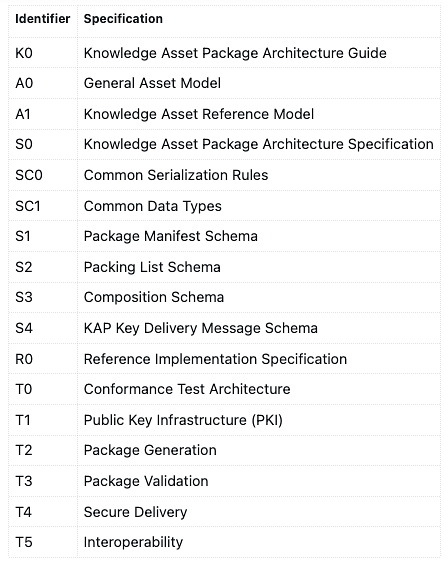
Together, these specifications define the conceptual models, package architecture, common rules, package schemas, reference implementation, and conformance tests that constitute the Knowledge Asset Package Specification Suite.
Each specification is independently versioned and evolves independently. Changes to one specification are intended not to require changes to unrelated specifications.
4. Architectural Layers
The Knowledge Asset Package Specification Suite separates architectural concerns into distinct architectural layers.
Knowledge Asset Package Specification Suite
│
├── Reference Models
│      ├── A0 General Asset Model
│      └── A1 Knowledge Asset Reference Model
│
├── Package Architecture
│      └── S0
│
├── Common Specifications
│      ├── SC0 Common Serialization Rules
│      └── SC1 Common Data Types
│
├── Package Schemas
│      ├── S1 Package Manifest
│      ├── S2 Packing List
│      ├── S3 Composition
│      └── S4 KAP-KDM
│
├── Reference Implementation
│      └── R0
│
└── Conformance Tests
       ├── T0 Conformance Test Architecture
       ├── T1 Public Key Infrastructure
       ├── T2 Package Generation
       ├── T3 Package Validation
       ├── T4 Secure Delivery
       └── T5 Interoperability
Each layer addresses a specific architectural concern while building upon the abstractions defined by the preceding layers.
Together, these layers separate conceptual modeling, package architecture, serialization, implementation, and conformance into independent architectural concerns.
5. Fundamental Concepts
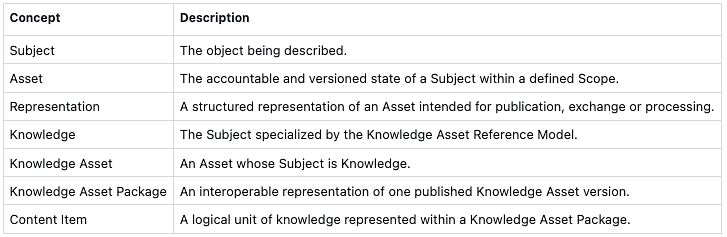
The Knowledge Asset Package Specification Suite is organized around the following fundamental concepts.
6. Architectural Principles
The Knowledge Asset Package Specification Suite is based on the following architectural principles:
- Separation of Assets and Representations
- Organizational Responsibility
- Immutable Publications
- Separation of Logical Organization and Physical Representation
- Technical Validation before Trust Decisions
- Federated Trust
- Interoperability
- Extensibility
These principles provide the architectural foundation for all normative specifications of the Knowledge Asset Package Specification Suite.
7. Package Architecture
A Package consists of a small number of complementary architectural components.
A published Package MAY be accompanied by one or more KAP-KDMs for different recipients.
Knowledge Asset Package
│
├── Package Manifest
├── Packing List
├── Composition(s)
└── Files

KAP-KDM(s)
    │
    └── reference the Package
The Package Manifest references the Packing List and one or more Compositions and protects the integrity of the published Package through its digital signature.
The Packing List defines the physical files contained in the Package.
The Composition defines the logical organization of the represented Knowledge Asset.
KAP-KDMs are independent documents associated with a published Package. They enable authorized recipients to access encrypted Package content but are not part of the Package itself.
Together these components provide a complete, interoperable, and secure representation of a published Knowledge Asset.
8. Validation Model
The validation of a received Knowledge Asset Package consists of two independent activities.
Package Validation
│
├── Technical Validation
│      ├── Package Structure
│      ├── Package Integrity
│      ├── Digital Signature
│      └── Certificate Chain
│
└── Consumer Decisions
       ├── Issuer Trust
       ├── Product Support
       └── Version Compatibility
Technical validation establishes objective and reproducible facts about a Package.
Consumer decisions determine whether a technically valid Package is accepted and processed.
Different organizations MAY legitimately reach different decisions for the same technically valid Package.
9. Typical Processing Flow
The following lifecycle illustrates the typical publication, exchange, and consumption of a Knowledge Asset Package.
Knowledge Asset Version Ready for Approval
      ↓
Approve Knowledge Asset Version
      ↓
Create Package
      ↓
Sign Package Manifest
      ↓
Publish Package
      ↓
Create KAP-KDM/s if required
      ↓
Receive Package
      ↓
Technical Validation
      ↓
Recipient Decisions
      ↓
Accept or Reject Package
This workflow separates publication, technical validation, and organizational acceptance into distinct stages. The actions performed after a Package has been accepted are outside the scope of this specification suite.
10. Reading Guide
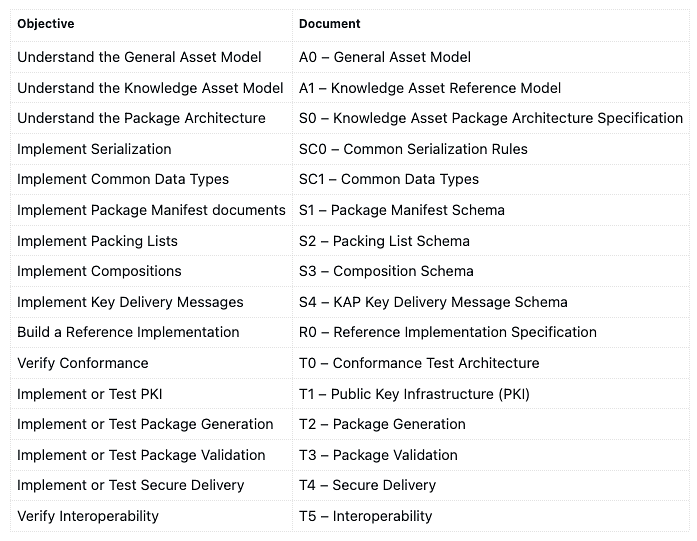
The following table helps readers identify the most relevant document for their objective.